Written by a human
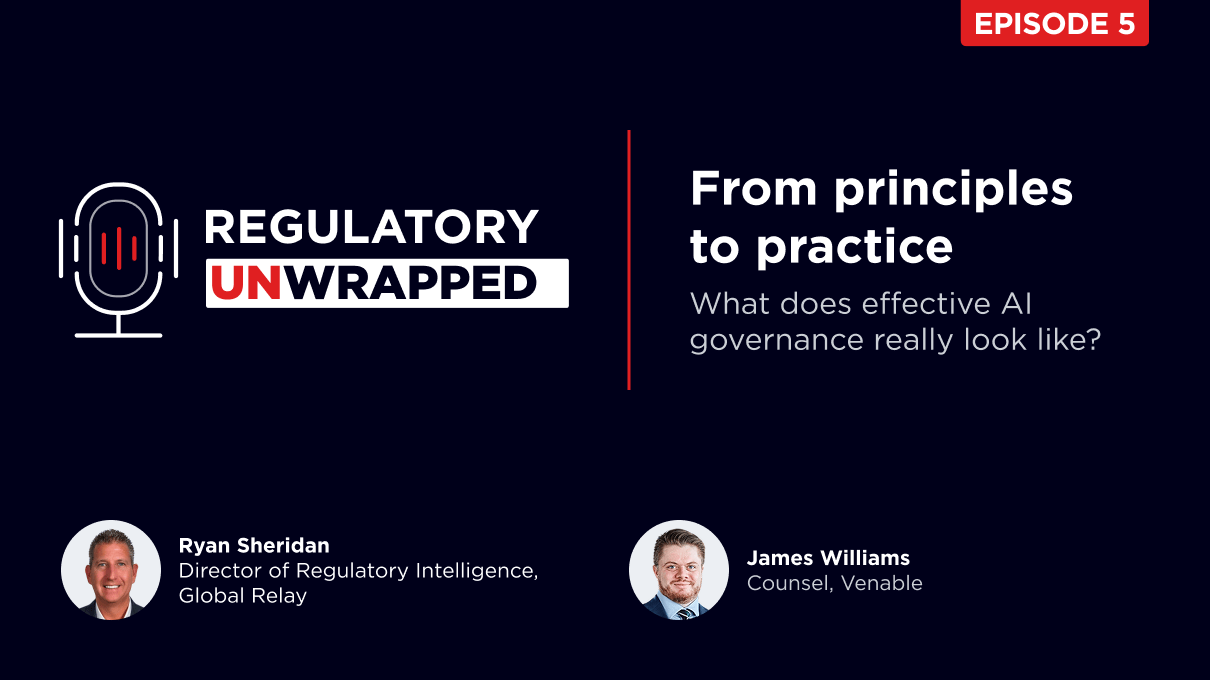
Regulatory Unwrapped: From principles to practice – What does effective AI governance really look like?
Discover how U.S. regulators are rethinking rulemaking as new technologies emerge and where firms should be focusing attention to ensure their governance keeps pace.

Note: This podcast was filmed on September 22, 2026. The information and opinions expressed reflect the regulatory environment as it stood at the time of recording.
Join financial services industry experts James Williams, Partner at Venable, and Ryan Sheridan, Director of Regulatory Intelligence at Global Relay, to unpack how U.S. regulators are rethinking rulemaking as new technologies emerge. Firms are more frequently leveraging artificial intelligence (AI) in operations — but is guidance keeping pace?

Check out the full episode to learn more about where firms should be focusing their attention to ensure their governance evolves to keep pace with AI:
1. How are regulators striking the balance between innovation and oversight?
- As firms use AI for unique use cases, federal and state regulators are determining how to approach oversight and whether existing frameworks are sufficient.
- The Conference of State Bank Supervisors has set out AI supervisory frameworks. Certain states have also issued guidance, such as Colorado’s proposed regulations under its automated decision-making law.
2. How are regulators and examiners approaching model governance?
- Federal banking regulators are asking about AI in routine exams, including how firms use it, risk profiles, human-in-the-loop controls, data security, and backup plans.
- Examiners aren’t just evaluating responsible AI use; they’re also looking to understand how firms use AI models in their operations. They aren’t passing judgement, but they do expect governance to be well documented, explainable, and auditable.
3. How should firms think about prompts and outputs when using generative AI?
- Firms are using generative AI (GenAI) for various functions, but most aren’t currently capturing AI content. As tools become mainstream and materials become client-facing, regulators will likely weigh in on AI record retention expectations.
- Accuracy and data privacy are paramount as firms adopt GenAI tools. Firms need to portray AI use accurately, flag risks as they arise, and maintain human oversight.
4. What legal considerations should firms keep in mind when outsourcing AI tools?
- Regardless of which AI services are acquired from vendors, firms are ultimately responsible for outputs. Firms should establish third-party risk management frameworks, ask about their vendor’s model governance, and understand the potential liability outlined in their contracts.
- Regulators are emphasizing systemic and concentration concerns when it comes to vendor risk management, including where AI models sit within an organization and the blast radius if an incident occurs.
5. Are there concerns about AI and accountability at the c-suite level?
- Many firms are assessing technology spend at the top of the house and ensuring they have proper controls and risk assessments in place. The expectation is that firms have people in the right seats making the right decisions.
- When dealing with AI models that perform core business functions, it’s important to understand how it will impact the company if something goes wrong, both from a headline and business continuity risk perspective.
Regulations may still be developing, but that doesn’t mean firms should wait to develop their own AI governance policies. Existing regulatory guidance offers firms a great starting point to strengthen model risk management frameworks and maintain effective oversight of AI tools within their ecosystem – whether built internally or by a third-party provider.
Tags

Global Relay Connectors
Archive data from any channel. Explore our range of connectors to collect, store, and access your communication data for complete compliance.